Stay & plan
One night is enough.
Two nights is correct.
Everything practical about visiting a town that only exists after dark: the train, the lanterns, the Hotel, and the small print — which, this being Traverse Town, is unusually kind.
Getting there
The evening train
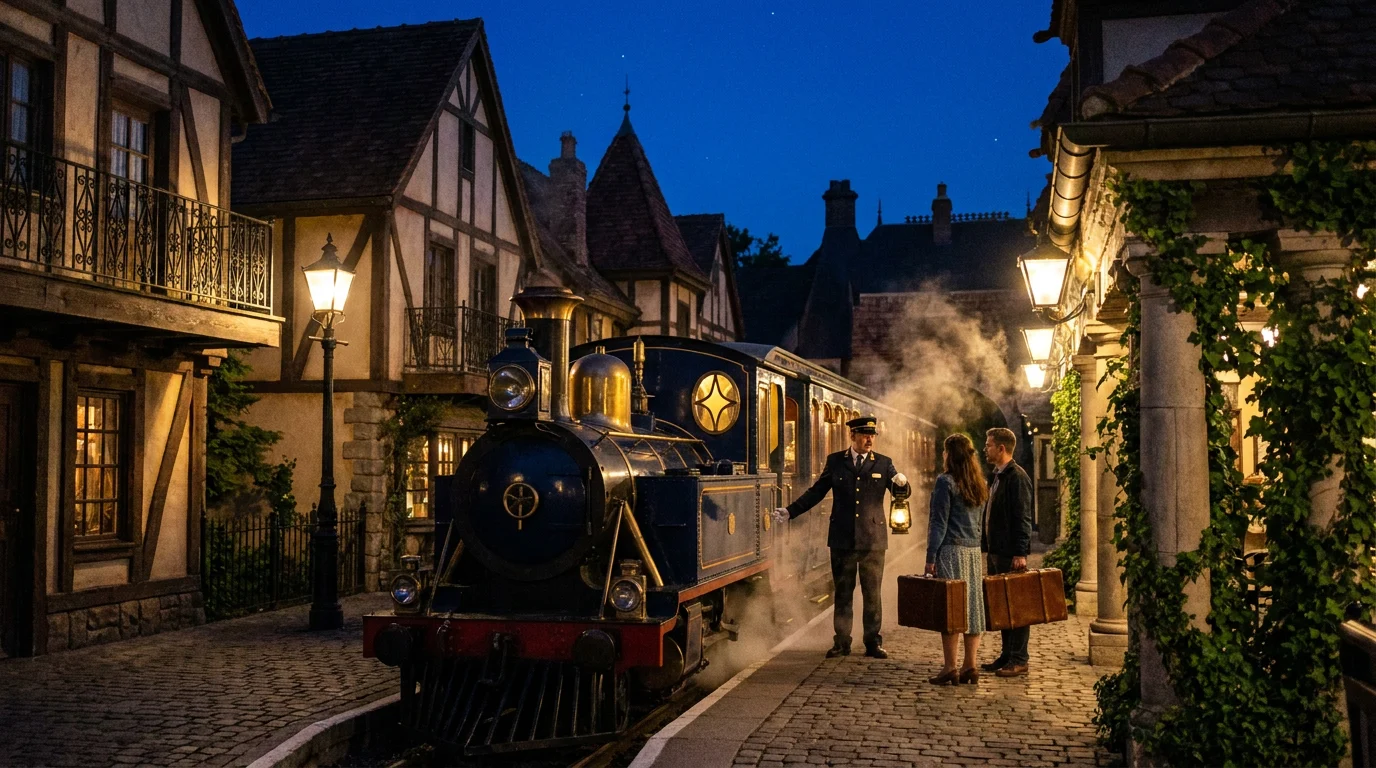
There is no parking lot, no rideshare curb, no highway exit. The only way in is the twelve-minute rail line from the coast town, on a midnight-blue train whose star-shaped windows begin the trip lit warm and arrive dimmed — so that stepping onto the platform, your eyes are already the town's. Trains leave every twenty minutes from an hour before dusk until one, and run back until three.
Porters take your luggage at the coast station and it appears in your hotel room or a First District locker. Wheelchairs roll aboard flat; strollers ride free; the last car is the quiet car, always.
Lanterns & tickets
Three thousand, then the town is full
Your ticket is a lantern — an actual small brass-and-glass lantern, taken from the wall of three thousand by the gates and carried, hung on your belt, or ignored in your bag all night. When the wall is empty, the town is full, and it stays full-not-crowded: three thousand people across forty acres is a dinner party, not a crowd.
One price includes everything: every wonder, every show, the Waterway, the carriages, the Synthesis Loft, the Post's stamp. Food is the only thing sold inside, because the market stalls' keepers insist their fictional grandmothers would never give it away — and even they run a quiet tab of free bowls that the town settles nightly, no questions logged.
Return your lantern at the doors, or keep it for a fee that plants a tree on the coast line. Most lanterns come back. The town likes that about you.
The Hotel · Second District
Forty-six rooms, two colors of dream
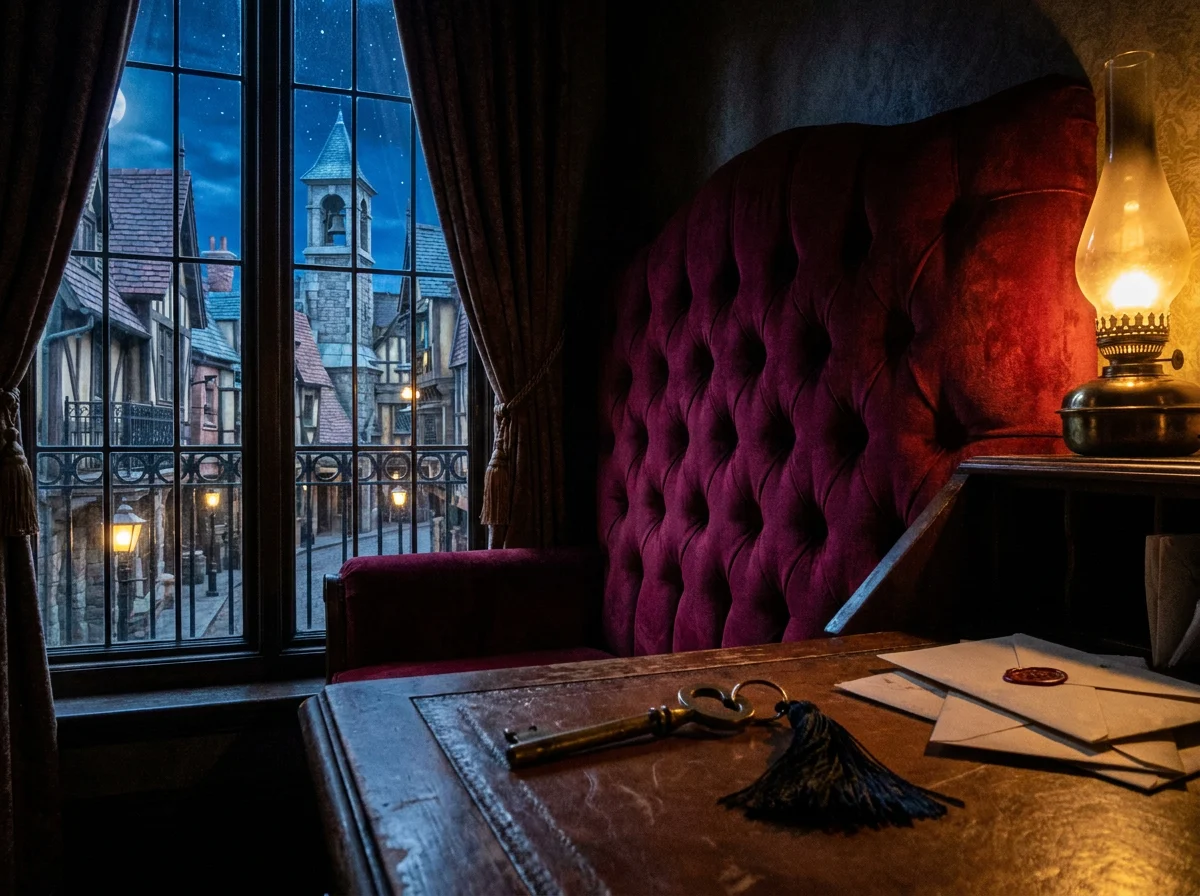
Half the rooms are crimson — velvet, lamplight, the good kind of heavy; the other half emerald — cool linen, fern-glass, windows that catch the garden air. Every room is named for a world nobody can quite place, keyed with a brass key on a tassel (there are no cards; the desk enjoys the ceremony), and aimed at a view: rooftops, bell tower, or the millpond and Merlin's lean.
Overnight guests hold the town's rarest privilege: after two. When the gates close and the lamps go down, hotel guests may walk the districts in the low light with the cats and the last of the lamplighters. The town asleep is a different park — slower, closer, entirely yours — and it is the reason "two nights is correct."
Wayfinder secret: ask the desk for the star ladder. It's a real ladder, to a real widow's walk, with a telescope and a thermos left out. One party a night. The cat comes with; that part is non-negotiable.
Hours & weather
Open at first star. Closed at two.
Dusk moves, so the town moves with it: winter nights start near five and run long; summer nights start late and end at three. The bell is always midnight. "Dearly Beloved" is always last. Check the season's card at the coast station, or trust the sky — the doors open when the first star shows, which is the only opening time we've ever needed to print.
When it rains, the town does not apologize; it performs. Awnings unfurl in sequence down the shopping streets, the Waterway's ceiling drums, the market stalls hand out broth "for the walk," and the lamplight goes soft and doubled in the cobbles. Regulars pray for rain. There is a small society of them. They have a pin.
In deep winter, the braziers come out, the Kitchen moves to mulled everything, and the bell show is the year's best — cold air carries light further, and the town spends that fact extravagantly.
Amenities & access
The town's hospitality, itemized.
A sanctuary that only works for some people isn't one. This list is maintained as seriously as the bell.
Free, throughout
Lockers, blankets, stroller loans, rain capes, water fountains (chilled, and one rumored to be lightly enchanted), wayfinders, and every repair Cid can manage. The town has no upcharges inside the doors. None.
The Still Room
A thick-walled, softly lit quiet room with no theme, no music, and no questions — for overwhelm, for grief, for nursing, for prayer, for nothing in particular. Smaller cousins sit behind the Gizmo Shop and the Gummi Dock.
Cobbles, solved
Every cobbled street carries a smooth carriage-stone lane, flush and unmarked — period-correct and wheelchair-tested nightly by staff who use wheels themselves. All six districts, all wonders, step-free. The rooftops have a lift the town disguised as a dumbwaiter and is smug about.
Maps of loudness
The park map shades every street by light and sound level, hour by hour. Quiet hours are posted and kept. Ear defenders at every district door; the Hundred Acre Wood is the town's certified soft place.
Signed & captioned, nightly
Every show, every night — not on request. A third of the residents sign; the Post accepts letters in any language and answers in kind, with the writing room's one polyglot moogle allegedly doing the heavy lifting.
Service animals & small humans
Service animals welcome everywhere, including the boats (there are dog-weight blankets). Nursing parlor by the fountain. Kids who fall asleep mid-visit are a design outcome, not a problem: carriage loans run till close.
Asked often
The short answers.
Is it scary at night?
No. The town is dark the way a bedtime story is dark — the shadows are set dressing and the lamps always win. The closest thing to a monster is the DO NOT lever, and you already know you're going to pull it.
Do I need to know the stories it comes from?
Not at all. Travelers who do will find the town winking at them constantly; travelers who don't get the better deal — they just think this is how the town is. Both are correct.
How far ahead should I book?
Lanterns: a few weeks, more for rain season (see above, re: the pin society). Hotel: months, honestly. The after-two privilege does that.
What should I bring?
A layer for the small hours, shoes for cobbles, and pockets — the town fills pockets. Everything else is loaned free at the doors.
Is the town real?
It's a work of imagination, and it says so on every page. But you already knew, and you read this far anyway — which is, the town would argue, how all the best places exist.
“May your world find you.” — said at the doors, at two, to everyone